Recently in Session reports Category
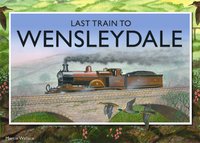
I was fortunate enough to make it to the game night this week. Last Train to Wensleydale was most wanted of the new games, so we got full four players. Short version: it's good and worth buying.
Description of the game
Players build small railroads in the Yorkshire Dales, moving cheese, stone and passengers. Passengers are tricky, because they have specific needs, they need to reach the NER or MR network. Stone and cheese are easier to move.
Everything hinges on influence. There are four sorts: government, train, NER and MR influence. Players get influence from a Amun-Re style auction. Government influence determines track building order and is necessary to get rid of complaining farmers who want to block progress. Train influence is super important, as it's needed to rent trains and it also determines the order of goods movement. NER and MR influence are needed a bit in the track building and a lot in the end of the turn (I'll explain later).
Track-building is easy. You can only build one continuous stretch each turn, no forking! Track has a cost, which you can pay in investment cubes (= money that's replenished each turn) or influence. Building must start from a MR and NER town or from own track.
In the movement phase players rent trains of varying capacity and move stuff. Cheese can be moved if your track reaches the area where the cheese is, stone moves if your track is next to the hill with the stone. This is pleasantly simple. Red passengers want to reach a MR town, green passengers want to reach a NER town.
Players get profit from goods moved and collect those for end game scoring, loss is accrued from track on board. Placement on profit/loss track determines general turn order.
In the end of the turn, players can make one of the big companies to acquire their track. It takes a connection to a company town and some matching influence. No more losses from useless track! This is very important phase for the general well-being of your company.
This goes on for four or five rounds. After that you score your profit or loss, 1 point for each good moved during the game and 2 points for each set of four different goods.
Our session and my impression
I like the game. It's fairly hard to grok, I think we got it pretty much on the second or third round. Next time it'll go better. The rules aren't super clean, but we got only one thing wrong (the cost of takeovers). Still, takes a while to explain them.
The setup is notoriously tedious (two cubes are placed on each area, then wrong-coloured cubes - white on lowland, orange on hills - are removed, then passengers are placed in towns) and indeed a bit annoying. There's some fiddly tracking of influence, too.
The game took about 110 minutes. A bit long, but full of action and I can see fast experienced players playing this in 90 minutes. Still, two hours is fairly well justified, there's meat in the game (and I'm not talking about the board, which looks like a bacon omelette).
There's lots of clever stuff going on. I like the auctioning for company influence, the track-building, collecting goods and the takeovers - most of it, that is. Last Train is pleasantly different from the collect-the-shares train games and pick-up-and-deliver lot.
I started by building a track to Hawes in the middle of the hills. I kept the track the whole game, shipping plenty of stone to keep myself making profit. I also got some cheese and green passengers. The route had plenty of red passengers, but it took some effort and two turns of track-building to reach a red town. On the last turn, I did a separate track to gather up some more cheese and green passengers. I wasn't very efficient with the takeovers, so on the last turn I ended up on -3 in the profit/loss track.
However, I was the best with goods, gathering 34 points from four sets and ten more goods cubes. Petri got 23 (least cubes, +5 profit), Hannu 20 (29 points in cubes, -9 mostly from unnecessary track) and Tuomas 11 (21 points, -10 on p/l track).
I'm very glad to own the game and definitely want to explore it more. The different setups will lead to different games, so I suppose there's quite a bit of replay value there.
Olli and I played another game of 1825 Unit 3 (our first game, our second game). Even though it was a while since our previous game, we got the game up and running in just 10 minutes. That was pretty sweet.
On company selection
I got the large private, Olli started NBR and I took Caledonian. Caledonian headed towards Carlisle, while NBR took the usual northern route. As usual, NBR withheld a lot, while Carlisle paid good dividends.
Next Olli started Highland in the north, while I started GSWR. CR and GSWR work really well together, as I saw in our first game, so this was an obvious move for me. HR and NBR have some synergy, too.
Caledonian was somewhat hampered by Olli's token play, he closed the city in front of Glasgow, so CR was limited to two-city runs between that city and Glasgow. Nasty. He did another foul trick to GSWR later on, I should've put more effort into playing offensive tokens myself.
More minors
Well, my companies paid better dividends and soon I had a lot more certificates. The game looked pretty clear, but we decided to slug it through. We started more minors. Olli started Great North of Scotland, again at low par, while I started M & C at £100.
That has been something I've wanted to do, and it was a good move. First, it got me more profit. Olli raised GNS from 550 to 1120, while I got M & C from 1000 to 1800. Second, after I paid £370 for the 3T train, M & C had enough money to buy a 5 train (sold to GSWR for £10) and pay something like £200 to CR for a 2 train. M & C bought another junk train later on so I could make space to get a 7 train for GSWR.
In the end GSWR was the king, running 7, 5 and 3 (exact same combo I had for NBR last time! NBR made £540 runs, GSWR had £530). CR had 3, 3 and 4, while NBR had just 3T. NBR's share value was for a long time below 50, allowing both of us exceed the certificate limit.
Final scores
I must admit I was a wee bit surprised in the final reckoning. On the last round we counted the profits on a spreadsheet and it turned out I beat Olli only 738-719. He had more cash than I had, but still I won, mostly thanks to GSWR, of which I owned 80%. My first count was 6648-6572, but typing this session report I noticed a mistake in my calculations and the correct score was 7648-6572, which is quite decisive.
Again the main owner of NBR lost - this has been the case in all three games so far, interesting enough. So, a good game. I now have two victories against Olli's one.
Variant rules used
I used some modifications from Dave Berry's Unit 3 kit DB3. We agreed the addition of the city of Berwick-upon-Tweed on the east coast was a good one. The east coast has been bit of a dead area, but adding Berwick made it more interesting and I ended up building a route there (it was a good route, too). So that's something I'll be using from now on.
Changing Dumfries to a small town and removing one of the mountains between Glasgow and Carlisle was interesting, too. Dumfries is an easy target for CR, this change makes the historical route to Carlisle more likely and perhaps slightly slows down CR in the beginning. Not bad, and I'll definitely try this again. The extra 58 tile necessary was also used, though not on Dumfries.
Adding a small town of Galashiels in the mountain didn't make a difference in our game. Dave's new stock price index, on the other hand, was an excellent addition. It shows the dividend payments necessary for different levels of price advancement, reducing the amount of mental calculation required a lot. Highly recommended!
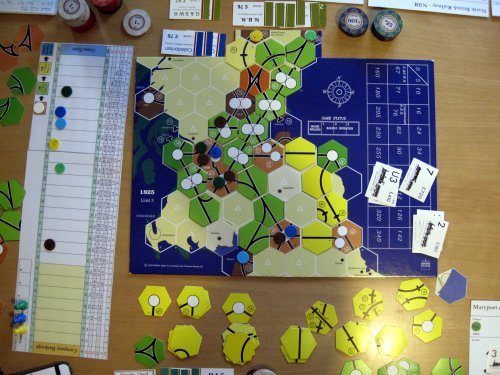
Picture of the board and the SPI after the game
I'm a wee bit late, since everybody played Ghost Stories back in Helcon last year, but I got it now as the Finnish version was published and we got it on the table today with Johanna - and got promptly butchered. It's one hell of a difficult game!
I suppose that's good, as beating the game is an actual challenge and I suppose that'll keep some people playing the game until they beat it and even then there's more replay value, but I'm pretty sure it'll be a turn-off for some, too. Kind of curious they did a Finnish translation, but I guess it's one of those "good chance to make a small print run" opportunities and Lautapelit.fi isn't going for the mass market with this one.
I'm not sure how I like the difficulty. The game looks splendid, if a bit busy, and seems a pain to explain. Well, now I understand the game better, having played it, so explaining it might be easier. I'm not terribly keen on it and I don't think it'll stay, but I do want to give it a four-player go - solid 75% of Geek voters thinks it's best with four.
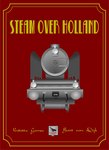
A while ago I got a chance to play Steam over Holland. I introduced two of the locals to 18xx, since I've got those DIY projects and the DTG order - those are mostly more complicated stuff, not very good for newbies. So, Steam over Holland, the friendly newbie game!
I was actually quite happy to try the game with just three players, because my earlier experience seemed to indicate that's the best number of players. It is - there's enough money in the game to make things more interesting. It's still a bit quiet on the stock market front, but we got five companies running well, which was nice.
I won hands down, no surprises there. I suppose the guys got a pretty good idea on some of the dangers with the trains. Petri got to deliver a nasty punch for me with a train purchase, after which I caused one of Hannu's companies to go bankrupt with the next train type.
Fun game, the boys enjoyed it, we played swiftly - slightly over three hours, including rules, setup and cleanup! - and my new Sidepot Venerati poker chips were great.
I was able to organize a longer game today. We ended up playing Roads and Boats, which was certainly welcome. I bought the game back in 2006 and played the only game so far back in 2005, so I'd say it was about time. Olli and Robert joined me, Robert had played back in 2005 and Olli was a newbie.
A quick rules explanation during the setup and off we went! This is a pleasingly simple game to explain, considering how difficult the game actually is. This time we didn't make the same mistake mixing mountains and rocks, so we got mines and gold a lot better. Still, that's all we did. I was just about to build my first coal burner when the game was over. Robert won with almost 100 points, he had four gold and rest of the points from the wonder. I pretty much chose to lose, as I decided to skip the wonder rush and try to actually build something.
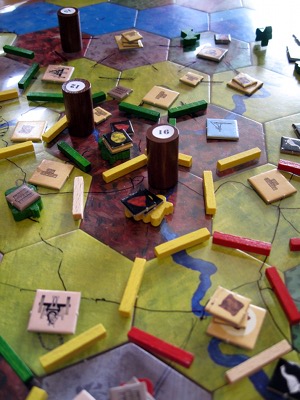
There was also a lot more fighting this time. Olli and Robert started building walls pretty soon. I was laughing, but then Olli rushed to my areas with a wagon and a donkey, straight to my brick yard. Ouch. I was able to seize initiative, though, and build, what, six or seven walls on my areas. If I hadn't, Olli would've built those walls and that would've been the end of my game, period.
I need a lot more practise. I'm pretty good at Antiquity after just six games, but Roads and Boats is still a mystery to me. With just few of these four hour slots each year (our game took 3.5 hours with rules explanation, setup and packing), getting Roads and Boats routine is going to be hard.
Johanna went shopping today and to my great surprise, bought a board game! She had found a copy of Piikkisiili (aka Polly the Porcupine), a children's game that has an age recommendation of 3+ and won the Finnish award for the best children's game in 2007. Since Nooa turned three a month ago, this was pretty much ideal.
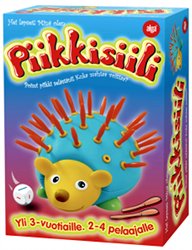
Nooa was really excited about the game. He first noticed the box when we were out playing in the park and wanted to immediately go home and start playing. Well, we had to eat first and it took us parents a little longer, with Anni needing food and all that, so Nooa was really anxious - he wanted to play real bad, right now. A real gamer there!
Well, eventually we got to play. It was fun, too. We played two rounds today and Nooa actually won both. The game is super simple: a porcupine is filled with spines of five different lengths. A die is rolled and everybody picks a spine. Depending on the die roll, the player who took the longest or the shortest spine wins.
Winner keeps the spine, while the other players put their spines back to the porcupine. That way there's a memory aspect, too, as you can try to remember the spines you've seen. I did my best, but still Nooa, who I'm fairly sure didn't care a bit about memorizing anything, won twice.
It's very simple and I can understand why some were bothered when Piikkisiili won the award (considering that for example Funny Fishing and Mago Magino were nominated). However, it's really good for three-year-olds. It's pretty much as complicated as Nooa can handle, as even now he had some difficulties understanding every detail. But he had fun, and playing Piikkisiili with him is fun, so I'm happy.

Steam is an interesting variant of Age of Steam. It won't make AoS obsolete, but it seems to stand quite well in comparison.
Things I like about Steam: the new income system where income can be changed into cash creates a whole new financial environment in the game. It's not quite as strict as in AoS, but interesting, definitely. New maps are always a new challenge. I've tried the US map, and the terrain there is quite challenging. It's good to have two different ways to play; I haven't tried the Basic game, but I think it's interesting.
Things I don't like: the graphic design is occasionally quite ugly. The game looks nice, but I prefer the clarity of Age of Steam. With three players the game seems a tad too loose.
So, overall a positive experience. I rated the game as 9 in Geek: not quite as good as Age of Steam (which I rate a full 10), but very good. They haven't ruined the solid foundation.
We played a three-player game yesterday and as I said, it feels a bit too loose. SInce they've made Urbanization and City Growth (used to be Production) better, there are more good actions. Of course, nothing beats Locomotive, but still. I think the first expansion should include a map for six players and a map and perhaps some changes to rules for three players.
In our game, I dominated the early game. By the time the other two were running two-link engines, I was already at five with a network that can use such an engine. At that point a first-time player expressed his frustration and I offered to swap places with him. That we did, and I proceeded to win the game from his hopeless position...
Well, not quite. We had to quit two turns early (having played for two hours at that point), at which point he won 45-35 or something like that. I'm not sure if I could've won, since while we all had six-link engines at that point and I had built a very good network, he had perhaps slightly more cubes to run. Hard to say what would've happened, I didn't count how many six-link runs I had left. With enough of those I might've won.
In any case it was an interesting experience and it made the game much more interesting, as I would've won the game quite easily without the swap, I think. Incidentally Petri didn't complain as much, but his position was much worse and I'm not sure if I could've done much if I had swapped with him.
It seems to me that it's slightly easier to succeed in Steam, as the financial system is more merciful. I was behind when we swapped, but I took plenty of money out, worked hard, paid back the debts and was fighting for the win by the end of our game, I'm not sure if it would've worked out that well in Age of Steam.

Gulf, Mobile & Ohio was requested, and I was happy to provide the game, especially as I had finally got the new board made by Sampo Sikiö printed. So, now we had new board and new shares, the same gorgeous style as the other Winsome Games Sampo has remade.
I played with Petri, Hannu and Robert. Petri and Hannu were also playing in the first session in November (which, it seems, I've forgotten to blog about), Robert was a newbie. The final results tell something about this game: Robert was dead last with 12 points, while Petri had 21, Hannu 23 and I won with 25.
Funny thing, about the result... At one point during the game, I scored two points for ridiculously low price of four dollars, as everybody else missed an obvious scoring opportunity. Those points would've belonged to Petri, I think, which would've meant a three-way tie at 23 points. Cool.
Hannu was swimming with money, but as he had mostly purchased cheap common shares, he didn't have plenty of points. I got an early lead, which I was able to maintain. In the end, Hannu made a mistake. GEO started in Atlanta, I bought it for a large pile of money and scored a lot. Hannu could've bought it, but decided to save money for the next company. Unfortunately it wasn't nearly as good and Hannu wasn't able to catch me, not with all his money. Unlike Wabash and other similar games, GMO is only about points in the end, so you need to convert your money to points, while controlling cash flow to ensure future competitiveness. I had excellent efficiency in converting dollars to points, while Hannu had great cash flow but not enough points.
This time we had a clue and the game was a lot more meaningful than the last time. Robert lost badly, which kind of proves the point that you need that one game under your belt to grok this game. I like this one, another good railroad game from Winsome.

After GMO, we only had time for a short game. So, we played Frantic Frankfurt. Robert didn't want to play Flix Mix, because he wanted to spare his brains, but agreed to join Frantic Frankfurt - which is of course at least four time as taxing. Classy move.
Frantic Frankfurt is a speed game, where players try to play their cards on common piles. There are only two rules. Cards have colours and numbers. You can either put a larger card over a smaller card of different colour, or you can put a smaller odd card over a larger even card of same colour.
Simple, isn't it? Well, actually it's everything but, especially as you have to play as fast as possible. I completely screwed up the first round. Which leads us to the main problem with the game: noticing mistakes -- not to mention correcting them -- is really, really hard.
If you don't mind that and play with people who aren't likely to cheat, Frantic Frankfurt is a fun challenge. I did really bad in the beginning, but then caught on and eventually won the game. Not a bad experience at all, quite an adrenaline rush actually.

During yesterday's game session, I was able to play the two games I most wanted. First we played Greentown, a rather excellent route-building game. Players develop the board to make the most beneficial tourist routes. Route cards specify the length of the route and the mandatory and optional locations to visit. Visiting places makes you money, but if you visit opponent's location, they get the money.
So, you want to both keep your own routes private while placing your buildings so that your opponents must use them on their routes. Rather delightful. The route-building is taken from 18xx games. You can either build new tiles or replace old ones to change the routes.
This is a very analytical game, where you can really get stuck on planning those routes. We played 21 turns in almost 60 minutes, so on average we took almost three minutes per turn. Kind of slow, and the players weren't that slow. I would avoid the game like plague with very AP prone players. With swift enough players, Greentown is excellent.
The other game we played was also an 18xx derivative, JC Lawrence's prototype Corner Lot, which is based on the private company auction phase of 18xx, made into a full game.
It's all about auctions and set collecting, and a rather clever game, too. I liked it, but I played it with the wrong people, as just about everybody else hated it... Too much calculating, wrong kind of calculating and too much information, too. I liked it, however, it's an interesting challenge and requires some thinking, as money soon becomes scarce and you have to both collect good cards for yourself and prevent opponents from making too good sets.
If you're interested, check out the short rules (a PDF file) and playtest kits are also available. The game is just 45 cards and poker chips, so it's easy to assemble and a fairly complete game.
Yesterday's session started with an interesting game of Wabash Cannonball. We only had three players, so it was a different game to start with.
I managed to lose the game on the first round. I got shares of PRR and C&O (red and yellow), probably the two weakest choices, while Sami got NYC and B&O. Hannu was left without shares. I obviously made an empty capitalization, but Sami chose to expand. Hannu bought a share with his superior finances, then I did another empty capitalization to stop him from getting two shares.
Here was my mistake: I persuaded Hannu to buy a share from Sami's company. In the hindsight, I should've had him buy one of mine. The rest of the game was pure misery, less said about it the better. Still, Wabash Cannonball is a great game, can't help it.
Hannu won, 142-120-84. Sami was second and probably handed Hannu the victory by driving B&O to Chicago, giving Hannu free option to Wabash Cannonball. I could've bought it, but Hannu had a turn before me, so Hannu would've diluted the company immediately, so I couldn't afford to bid too much. Hannu got it and made a nice profit. Of course, Sami had only played once before and that's advanced strategy.

We had time for something short, so we played two games of Die Dolmengötter. My rating of 10 is so correct for this game, it's definitely one of the very best. Of course I won both matches, the second one was particularly sweet as I beat Hannu with the tie-breaker. Sweet. This is an amazingly good game.
An opportunity presented itself... We decided to put Nooa in temporary day care so Johanna could get a break and I could get some board game time. There's a nice private day care center next to the university where we play, you can drop your kids there for an hour or few. That worked out well, Nooa had fun, and I was able to play games for two hours.

I presented a list of options and Hannu and Petri chose Steel Driver, since they hadn't played it before. I was curious to try the game with three.
Turns out three isn't the optimal player count for this game. The auction loses some tension, as it's obvious that each player will buy two shares each turn. I can't see many possibilities to upset that balance, unless someone spends a lot to buy a single share or a company becomes too weak to buy. I really liked trying to figure out how to gain an advantage in shares, that was a fun part of the five-player game.
In the end, it was very balanced. I had 520 cash, Petri had 620 and Hannu had 640. Our stock portfolios were even more even: me and Petri had 1160, Hannu had 1130. So, I lost with 1680, Hannu was second with 1770 and Petri won with 1780 - and during the game I once told Petri not to fuss about a single build, as whether he gained $20 or $30 doesn't really matter in the end...