Recently in More about games Category
I got some new children's games to try out. Couple of them were instant hits (Zoowaboo doesn't look like it's really hot with two, so it's still waiting) with Nooa.
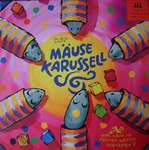
Mouse Carousel has six tubes and seven mice with different colours. There's some cheese cubes on the middle of the tubes and to get to that cheese, you need to push the seventh mouse to one of the tubes, making another mouse appear. If the colour of the mouse matches the cubes, the mouse eats the cubes and you get another go. If you fail, it's next player.
A simple memory game, then, but remembering which mouse is where is bit of a problem, especially if the game is played fast enough. The constant switching of places can be a bit taxing and takes some proper concentration. However, the idea is simple enough that a three-year old can figure it out and actually play competitively. Just minimize all distractions - one games was totally ruined by a TV that was on at the background, Nooa was so distracted his playing was completely random.
The game looks gorgeous, but has some usability issues. Red and orange cheese is nearly impossible to tell apart in weak light and at least my copy has blue cheese cubes matching to a mostly purple mouse. The mice are marked with small stickers, which may or may not last, but at least the game comes with a set of spares.
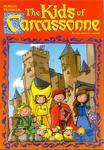
Kids of Carcassonne simplifies Carcassonne for four-year-olds. It's simple enough that Nooa, three years and five months now, can play it correctly. He doesn't really have a clue of strategy, but with some practise I'm sure it'll come to him.
This one also looks gorgeous (and is, like Mouse Carousel, illustrated by Rolf Vogt). The tiles are extra large, as are the meeples. Every tile fits everywhere, as all have roads leading to every direction. Players try to complete roads (which is easy, as there are terminals on most tiles). Whenever a road is done, players get to place their meeples on the road, each non-terminal road piece has a picture of one of the kids. Just fill up with correct meeples, very simple. Winner is the player who first gets rid of all eight meeples. No counting involved!
Kids of Carcassonne is a winner, because it works so well with kids and adults can enjoy it, too. Actually, once we got the kids in bed yesterday, we played three quick games with Johanna. She likes the game, more than regular Carcassonne. I think it's charming, too, but I don't think I'd take the game to a game club, even though it's a nice five-minute filler with adults. Regular Carcassonne can be played almost as fast and is more rarely decided by the tile draws. Still, this is a top-notch children's game.
I'm a train gamer, yes. I've got two Deep Thought games on order and I'm adding third (I've got 1826 and 18MEX, I'm adding 1889) and I'm right now in the process of building two more (recently liberated 18EU and the new and curious Japanese 1886). I can also hear 1844 calling for me from Germany, I think it's likely I'll buy it at some point. We're moving in few months to an apartment 30 square meters bigger than our current place and I'm kind of hoping the extra space will make it slightly easier to run some longer games every now and then.
My post-Essen game order looks like it might resemble last year quite a bit: a big Splotter game and the Martin Wallace train game. Greed, Incorporated seems pretty nice, though I have to admit Duck Dealer had a better theme. To speak of the game, I still haven't played it. About time, huh? Last Train to Wensleydale sounds interesting, though I haven't read the rules or anything. I'm hoping to try before I buy at Helcon.
What else... I haven't been playing games for a while, and I'm really itching to get some action. I've got Fauna, Coast-to-Coast Rails and a pretty hot prototype to try.
Age of Steam - Zombie Apocalypse sounds interesting, but expensive. Still, it seems like a relevant AoS expansion, as it's by Michael Webb.
In general the new Essen stuff seems relatively uninteresting. Finnish Board Game Society has really good forum discussion on the new games. I haven't been following BGN lists this year, but the forum notes on new games are generally even better. Endeavor is getting interesting affection - it's a short one, that's always a bonus. I'll try this one at Helcon, definitely. Peloponnes might be fun.
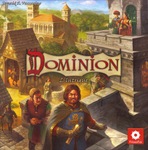
My brother came to visit and I got a chance to try the new Dominion: Intrigue, the stand-alone expansion for Dominion. We played through the three default setups listed in the rule book, which gave us a pretty good idea of the different cards in the expansion.
There's lots of new stuff in the expansion. There are for example victory point cards that actually do something, like offer actions and money. My brother used Great Hall (1 VP, +1 card, +1 action) to good effect and Harem (2 VP, +2 money) is another attractive card.
Many cards offer extra choices, like the Pawn, which gives you the choice of two from one money, one card, one action or one buy. There's actual decision-making in the cards, gasp! Some of the new attack cards I don't like that much, like Saboteur, but some are really nice (like Swindler: opponent destroys a card from top of the deck, you replace it with another card of the same price).
All in all, this is a great expansion. As a stand-alone game, not quite as elegant as the basic Dominion, but if you like the basic game, this is a must buy expansion, no doubt about it.
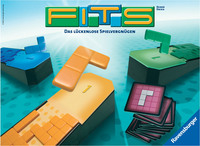
I got myself a copy of FITS, the Tetris-like game from Ravensburger. It's a fun little puzzler, where players must fill up the space with polyominoes - like Tetris bits, but this game also includes those with three or five squares. Each tile will appear exactly once in a random order and the rules are slightly stricter than in Tetris, since there's no moving sideways. Badly placed tile will block a lot.
There are four rounds, each with a different scoring rule. In each round, every empty spot is one negative point. In the first round, extra points are awarded for completed rows. In the second, for spaces with point values. In the third, there are positive spaces and very negative spaces. In the last one there are pairs of symbols: if both are showing, it's points, but if only one is out, it's negative.
It's very simple and plays relatively quickly. It's very multiplayer solitaire, the number of players doesn't matter a bit. The rule book includes a scoring scale for solo play. However, I don't find the solo game that interesting - the game is more fun with other people. It's not brilliant, but so far I like it. What's even better, Nooa liked it a lot and had great fun playing with the (sturdy plastic) tiles. That might be the reason to keep the game.

Yesterday I played a game of Steam. Again we had three players on the US board, but this time using Basic rules. Those are actually pretty good! Of course, they remove quite a bit of the tension, as the auction is gone and the money is a lot easier (no loan-taking in advance, just go down on the income track when - and only when - you need cash). The basic game is still the same, though: get a good engine, build flexible track, secure cubes for future deliveries.
So, in some ways the basic game makes things easier - new players will need to do less challenging forward planning - while keeping the game interesting. It's not a bad mix, and I wouldn't mind playing the Basic game again. My preference is still the Advanced game.
In our game experience paid off. I built a gorgeous network - a large ring of about 4-5 cities and 4-5 towns, then urbanized another city outside the circle and connected it several times to my ring and for the final touch built a route across the ring. In the end, I would've had six-link deliveries for two or three turns more. It was very pleasing to build. Final scores were about 79, 73, 59 or so, so it wasn't a slaughter or even a particularly obvious victory in the end, thanks to the split income and VP tracks. In Age of Steam, this would've been brutal.
I've been living in a gaming void... Excluding the play-by-web games, the Bezique match is the only game I've played since Anni was born. It's still a bit hectic to go out and play, but it doesn't stop me from thinking about games.

I've found Günter Cornett's Greentown and I'm seriously thinking about buying it. The game is generally described as the track-building aspect of 18xx games and nothing else - sounds pretty sweet. The BGG reception is not very good, but also may be a slightly confused. I don't know, but the game does sound fascinating.
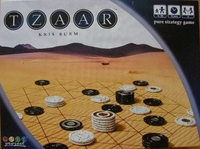
I'm also thinking about buying Tzaar to complete my Gipf collection (I still don't have and will not have Pünct, but that doesn't count). I think the Gipf brand is good, because I'm not very keen on abstract games in general, but Gipf games manage to capture my attention and get me interested.
Funny thing - as something like Kamisado just didn't attract me at all, even though I think it has similar depth as the Gipf games have. Part of it is the style, as I really like the black-and-white aesthetics of Gipf and find the colourful mess of Kamisado disgusting, but still... part of it must be the successfull Gipf brand.
Then there's the question of Canal Mania - I have the first edition, I like to play it and now I'm wondering if I should buy the second edition or not. Is the second edition essentially better than the first? I think I like the concept of junction contracts and the possibilities they allow, but is that worth the money switching editions costs? If I can sell the first edition for a good price, then buying the second would be easy, but... I don't know. Any suggestions?
I went to the Helsinki Book Fair yesterday. I was interviewed about my card game book, we did a quick 20-30 minute session, which went really well. I'm becoming a professional author, obviously, I can actually do public performances.
I knew that Lautapelit.fi had a booth at the fair, so I arranged to pick up a copy of Race for the Galaxy: Gathering Storm. As it happened, they got the Finnish edition of Dominion out sooner than announced, so I was able to get that one too. Cool.
Gathering Storm is nice. There's not much stuff in the box, but it seems good. The cards are interesting. I don't care much about the solitaire version - I'll try it, sure - and the goal tiles may be good and then again maybe not. We'll see. Still, the new stuff seems like it's worth the price.
Dominion seems pretty cool. I wasn't able to figure out the game from the descriptions I've read so far, but now I've read the rules it all clicks and sounds seriously interesting. Fortunately I'll get to try it tomorrow, I believe. Based on rules, it sounds good, but I'll have to see how it works out in practise.
The Christmas is coming, by which I mean Essen. There's a pile of new games getting published, but I'm really not very interested in most of them. I mean, there's plenty of nice stuff coming, but in the end, I don't really care.
I must say we've had excellent service on the Board Game Society forums, where Oskari has been reading the rules to just about every Essen release and has already posted 15 reports. Great stuff.
However, there are few titles I'm definitely interested in:
- The Winsome Essen set (Gulf, Mobile & Ohio, Preußische Ostbahn, Wabash Cannonball Erie Expansion and AoS: Texas, Oklahoma & New Mexico). I'm on the list, so I will buy this. For the record, I don't care whether John Bohrer or Martin Wallace is right. Whatever's going on between those two guys, I don't let it come between myself and some good games.
- The Queen Games version of Wabash Cannonball aka Chicago Express. I'm interested, but I think I'll wait and see if they're doing a Finnish translation of it.
- Duck Dealer, which is the odd new Splotter game. Buying and selling cheap crap in the world of intergalactic trade? Complex planning, infrastructure development, route-building... From Splotter. 100% non-avoidable. Must-buy. Won't think twice. Something that needs to be bought pretty soon, though the 1500 copy print run will last for a while. Only 200 copies available in Essen, so having some patience helps.
- Le Havre from Uwe Rosenberg - Agricola 2? I actually don't know much about this, haven't bothered to read all the reports, but yes, definitely interesting.
- Race for the Galaxy: The Gathering Storm is mostly a question of when. Great game, interesting expansion, a must-buy.
- Dominion is interesting, particularly since there's a Finnish edition available. I'm not rushing to buy it, but wouldn't mind a review copy... (hint, hint).
- Steel Driver is Martin Wallace's idea of developing Prairie Railroads further. Since Wabash Cannonball shares the same roots, this'll be an interesting comparison.
And that's pretty much it. I'm pretty sure there are copies of both Duck Dealer and Le Havre available in Helcon, so hopefully I'll get to try them there. There will be an obscene amount of new games to try, actually, since Markku from Board Game Society has begged dozens of demo copies of games from publishers. That's easy, since the games can be picked from Essen and sent to Finland by the Society work mules visiting the fair. So, any Finnish gamers interested in the new stuff should simply head to Helcon in late November.
Edit: Added Steel Driver.
Yesterday I re-installed 4 Winds Mah Jong, now that I have a Windows laptop in addition to my Mac. It's still as good as it was in 2002 when I bought it.
The game shines when practising new rule sets, particularly those with minimum scores - always pesky for new players. Having a computer opponent helps to get those practise games done so you can focus on actually playing the game.
I've been playing Riichi aka Japanese modern, which is more fun than I originally expected. I also tried the Korean game, which is played with just characters and dots, no bamboo tiles at all. Making pure hands is easier, but there are few tricks in the game.
Chinese Official International Mahjong rules is an interesting rule set to Mahjong, sanctioned by Chinese authorities. Seems like a well-rounded set of rules, with a minimum winning score and some rather interesting scoring hands (shifted chows and knitted sets, particularly).
Few relevant links:
- Chinese Official Mahjong rules, a rulebook in PDF
- World-Class Mahjong with World Champion Mai Hatsune is a good strategy guide to the game.
Playing Mahjong might be nice, it's been a while since I've heard the clicking of the tiles. I played few games at MahjongTime yesterday, that seems like a fun site. However, there doesn't seem to be many players playing when I would like to play, that's the problem with sites with lots of US players. Give me Brettspielwelt and European players...

I was writing about Cuba on the Finnish Board Game Society forums after my latest experience with the game and I think my friend Tommy hit the nail on the head on what I don't like about the game.
It's the lack of snowballing. Valerie Putnam wrote about Snowballs and Princess Brides on Boardgame News and here's the essential quote about snowball games:
Players start the game with minimal resources and must use what they have to build more. Slowly your meager beginnings, through careful effort, gain enough momentum to become self-sustaining. It's like a snowball that is finally solid enough to grow bigger just by pushing it down a powdery slope. The winner is typically the player who accomplishes this most efficiently.
In a way, Cuba feels like an economic game in the vein of Puerto Rico et cetera, but what you're able to do on turn six isn't much better than what you can do on turn two or three. Sure, you get more buildings, but the buildings are all the same, there's no "get small building, use it to get more stuff, buy a bigger building that's more powerful than the small building" effect.
And that, I think, is the biggest problem with Cuba. I don't get the sense of achieving something, it's all the same during the whole game.
Of course, the sense of achievement doesn't have to mean snowballing. Well, I think one can classify Age of Steam as a snowball game even though it isn't quite like the Puerto Rico family, but still: you start with minimal resources and build more. Building track produces income, which gives more options and so on... And in addition to the growing capabilities and satisfaction of actually making money, there's the sense of achievement from building track and watching the networks grow, making larger runs and so on.