Recently in Event reports Category
Helcon was last weekend. The event was again great success, with lots of good games available. Running the event just week after Essen proved a bit problematic, as some of the games arrived from Essen on Friday, barely in time.
I did a day trip for the first time, driving to Helsinki in the morning and driving back in the evening. It's about 2,5 hours each direction, so a bit of a driving, yes, and definitely not my favourite way to do it. However, it beat not going at all and with the kids it was the best I could do this year.
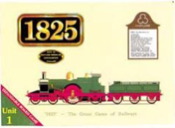
1825 Unit 1. I started the day with a scheduled 5-player game of 1825. I was the only one with 1825 experience and three of the players were total 18xx newbies. We managed to play the game in less than four hours (well, about 4,5 including complex setup and fairly quick clean-up).
We used all Regional Kits and the LT&SE kit and had a bank of 8 300 (I was aiming for 8 000, but didn't bother to remove three 100 chips to get the exact amount). The game actually ended when LNWR reached 340 on the SPI, one or two operating rounds before the bank broke. We were lazy buying trains, which kept the bank alive. It was a fun game and included some interesting challenges.
The setup was good, though I'd probably leave Wales out the next time. South Western England might stay or might go, North Norfolk on the other hand is a must and I'm likely to include it every time I play Unit 1. London, Tilbury and Southend is also easy to include every time, because in general minors are good.
Here's a picture of the board after the game (if you want to see a larger version, it's in the Geek):
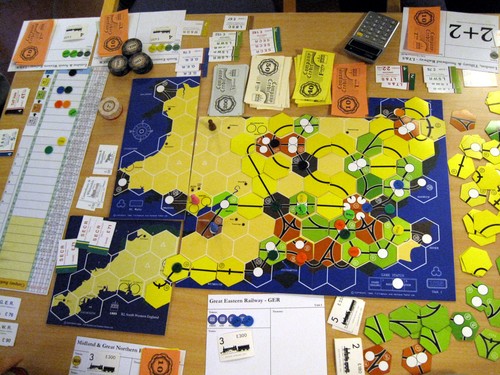

Age of Steam: Finland. We lost one player, but continued the train theme. Age of Steam Finland was a must! It's a tough map: it looks very wide open, but there are plenty of evil lakes that block building a lot. Many cities are easy to monopolize, as you can build all exits if you want to.
I enjoyed the map. The local colour is good: I was able to build track from Helsinki to Tampere to Pori to Oulu to Kuopio, nice round trip through Finland. The expansion is light on the special rules, there's Russia and Sweden that accept any colour and have cubes to use, but once the cubes run out they shut down. Simple, but interesting. Some of the players thought the map was too tight and with five players it's probably downright evil, but I like it and could see it used as a newbie map, thanks to familiar geography and easy special rules.
Bunny, Bunny, Moose, Moose is a party game hit. I think it's not that much fun and very dependent on having a good group. If I never play it again, I'll live a happy life.
Gonzaga. This is the game with the plastic ring thingies over the map of Europe. Clever ideas, somewhat meh play. Bland game, doesn't really stand out except for the garish components.
Pony Express. Liar Dice, racing to finish, dexterity element that includes throwing dice at pawns across the board. Strange combination! It actually works, which is somewhat surprising, and I'm fairly sure some people will love this. I'm not one of those people, but it was fun (especially as I won the epic duel in Sacramento). It was fun explaining the rules, as most situations ended in "and then you must go to prison".
That's pretty much it, for the new games at least. I didn't win Greed, Inc. in the raffle (I bought 16 euros worth of tickets and won a Finnish Board Game Society badge - not bad!), so I'll have to buy it (we're doing our annual post-Essen Milan Spiele order right now). I brought three boxes and a big bag full of games I had sold or traded or somebody else from Tampere had sold or traded and brought back three boxes of games for me and other people.
Now I have plenty of interesting games to try: Winsome set, Early Railways Collection, Railroad Dice (and Railroad Dice 2 and the German expansion), Dampfross and so on. Yeah, I got some train games (actually, about 40% of my collection is now train games or expansions to train games). I also got Dominion: Seaside and Vasco da Gama.
What else... I bought a copy of 1830 from BoardGameGeek. It's either moderately priced or hideously expensive, depending on whether the Finnish Customs Office gets it or not. My Deep Thought order - placed in August - has progressed, there's less than 300 games before me and current ETA is in March. I'll probably drop 1826 out of the order (keeping 1889, 18MEX and 1846), but if 18NEB is ready before my order is done, I might add that.
So many games, so very little time to play them...
Continuing from the part 1, part 2 and part 3.
Le Havre. I had already decided to pass Le Havre because I felt it was going to be too long for me anyway. Well, Tommy suggested it for my last game in Helcon and I agreed, because I do want to try it. We got a third player and played a quick three-player game -- that took two hours. So yes, too long, especially if it gets longer with more players (I'm not sure if it does).
But... it's really good. I mean, it's perhaps even better than Agricola. I don't know, but it's good. It's a similar resource management game. Get some basic stuff, turn it into more advanced stuff, buy buildings, use them, feed your people, all sorts of dealing and fixing. I liked it a lot.
However, I'm not buying. If I bumped into a cheap copy at some point in the future, I'd probably buy it -- but I think Le Havre would be a three-player game for me, and absolutely no slow players allowed nowhere near the game. While the game is good, I don't think it's good enough for three or four hours and I can see it fairly easily taking that long with undecisive players.

Galaxy Trucker. Believe it or not, I haven't played this one before. Ilari was kind enough to teach me the game. It's fun! First you build a spaceship under time pressure: you draw tiles with spaceship components and try to form them into a coherent ship that can do everything necessary.
Then you test you how you do: the ships start flying and cards are drawn. The cards have all sorts of features, mostly nasty stuff like space pirates or the dreaded meteor storms. If you have enough guns and shields you can survive, but most likely you don't have. Usually, it seems, the question isn't "will it hurt?" but "how much?".
The thing is, building a space ship is very hard. You want storage space, plenty of guns, good engines, shields, battery power for the shields and guns and engines, enough crew and so on. The ship structure is important, too, as you don't want loose connectors hanging out and the ship needs to be sturdy: you don't want a single meteorite to rip off half your ship (take my word on this, I've tried!). So, you must make compromises and that tends to spell trouble at some point.
There's plenty of luck, but this is a fun experience game, really. However, it's an experience game with a game included, too.
Sushizock im Gockelwok. This is a sibling to Heckmeck am Bratwurmeck. Both are simple dice games, with some push-your-luck in them. In Sushizock you try to collect good sushi tiles, but also need bad bone tiles, because you must match each good tile with a bad tile. Very simple, yet quite entertaining if you're into dice games. Harmless fun, but plays quick (quicker than Heckmeck, which has a tendency to overstay its welcome).

GiftTRAP. A party game where players are presented with an array of gifts. Everybody gives one of the gifts to everybody else. Then players rate the gifts and scores are counted: if you gave the correct gift to the right person, you get giving points and the recipient gets receiving points. Once you max out on both points you win.
It's simple and reasonably entertaining. Still, a party game is a party game and this one is of little interest to gamers, in my opinion. The idea here is somewhat clever, but of course you need to have a clue about your fellow players, otherwise the game will be relatively pointless. Many people seem to like this on BoardGameGeek -- almost 7 average rating is great for a party game -- but I'm in no rush to try the game again.
And, guess what! That's pretty much it. It was a really nice weekend of games.
Let's see what I didn't cover in part 1 or part 2... see also part 4.
GemBlo Pyramid. This dice-pyramid game is apparently good, if played with the expert rules. Well, we couldn't figure them out, so we tried the basic game. That one isn't good, since making the pyramids isn't particularly interesting and the game seems a tad too dependant on getting good dice. Or then not, but in any case, if I try GemBlo Pyramid again, the expert game it'll be.
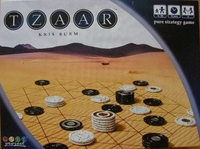
TZAAR. This is the latest entry in the Gipf Project and a surprisingly simple game. Both players have three types of pieces, but they all are functionally identical: all move like rooks on a hex grid and capture other pieces. First move you make must be a capture, other can be a capture or a stacking move. You can build stacks of your own pieces and to capture, the capturing stack must be at least as high as the stack being captured.
It's deceptively simple. The reason you have three kinds of pieces is the victory condition: you win when your opponent doesn't have all three kinds of pieces available. You also win when your opponent cannot capture. Very simple, yet of course deeply challenging once you get into it. This is a really fine abstract, I'd say, and one I'm eventually going to add to my collection, I think.

Kamisado - on the other hand - is less interesting. This is an ugly game, with really strange-looking pieces and very bright and colourful board - a far cry from the black and white elegance of Gipf games. Here a simple goal of getting your piece across the board meets an elegant mechanism, where the square the piece ends its moves determines which opposing piece will move.
Kamisado is very much about counting moves ahead and avoiding mistakes. Squares will become dangerous as opposing pieces have clear routes to the goal row, so you can't move to this colour or that colour until the enemy pieces have been blocked. Clever, but I didn't like it very much. This is certainly a game with possibilities for really deep play, but for some reason I don't find this nearly as charming as, say, the Gipf games.

Keltis. This board game version of Lost Cities won Reiner Knizia his first Spiel des Jahres. It was well-deserved. The game is a good family game. Play cards to advance on scoring tracks, very simple and yet quite engaging. Nothing I'd need to own, but fun to play, sure!
There are some extra features added to the basic structure, the scoring is simplified and as a clever change, you can play cards in either ascending or descending order. This makes things more interesting, when everybody isn't trying to get the same cards at the same time. The Irish theme is of course non-existential and perhaps a tad bland compared to Lost Cities, but at least the green board looks pretty. I do understand the Lost Cities re-theming Rio Grande did.
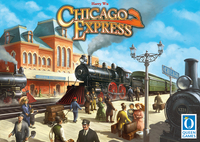
Chicago Express. This new edition of Wabash Cannonball is pretty. Typical Queen Games quality, that is. This time the game is excellent, too, which is an improvement as most Queen games haven't been that inspiring. I'm not in a rush to update my copy of Wabash, but this edition does make teaching the game a tad easier.
Well done, Queen Games, and congrats to John Bohrer for getting this deal done. I wonder how it was possible, since Bohrer doesn't seem like the easiest guy in the board game industry and I've heard similar things about the Queen Games boss... Who cares, when a game this good gets a treatment this fine.

Toppo. This one is fairly unknown considering it's a Knizia title published by Rio Grande and Amigo. Toppo is a speed game, where players quickly play cards, trying to "top" a set of three cards with colourful symbols that remind me of ESP test cards.
Topping a set means that every card shares a colour or shape with one of the cards on the table. If that happens, then the cards replace the earlier set and show goes on. First player to get to under ten cards wins. There's a hazy detail in the rules: if the cards need to match colour or shape, what if they match both? "Or" is a tricky word. The rules of the game are pretty bad for such a small game in any case. I missed few points (well, large part of problems were caused by reading the rules too quickly), causing the game to seem a tad tedious.
Played correctly Toppo might be an interesting speed game. Nothing like Flix Mix or Set, by no means, but something decent anyway. I'll comment more once I try this game with completely correct rules.
One more part, I think, and that's Helcon games covered.
Continuing my Helcon review, see part 1 here, there's also part 3 and part 4.
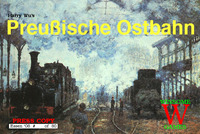
Preußische Ostbahn. Another Historic Railroads System game from Winsome, fairly closely related to Wabash Cannonball. However, this one's billed as "German family game". Indeed, the game is a lot more gentle - yet still quite a challenge.
This time the railroads are building in Germany. There are eight different railroad companies, each of which has a special characteristic based on its history. Köln-Mindener, for example, was focused on paying dividends, hence it can only spend $5 on track-building each turn. Each railroad has three shares and a bunch of track cubes.
The turn order mechanism is the key to this game. Each round players put cubes in a cup. The player in lead puts in one cube, the second puts two cubes, third three and so on. Then cubes are drawn from the cup, one for each player, and put in order on the player order track. That's how the turns are taken. If you're first (and there are more than three players), the odds are pretty good that you won't take a turn. For few rounds... This is a really nice mechanic, if you can tolerate not taking turns for a while. Of course, the important thing is to guarantee success even when you don't get turns.
Turns can be used in three ways. You can pass, expand a railroad or sell shares. Expanding costs money, increases the railroad income and triggers dividend payments. Every time two railroads meet for the first time a general dividend payout is triggered, with the railroad doing the connecting build paying double dividends.
Shares are sold in auctions, just like in other Winsome games. The order is somewhat limited: every company must sell their second share before any can sell their third (the game begins with an auction of the first share of each company). The game feels more gentle than Wabash because the shares won't dilute. Buy a share and you get the full value of the share added to your personal income.
I played the game twice, once with four players and once with three players. Both times there was lots of money in the game, with winning scores up in approximately $400. Strange enough, the four-player game was actually richer: the winner had $472, while I won the three-player game with just $391.
In the first game I thought we had a runaway leader, as one player had huge dividends. He did win, but I was second with $421, so the difference was smaller than I expected. The winner paid too much for some shares, that's why, I think. The strategy is somewhat hazy for now, but apparently the players in lead should invest in the companies owned by the players who are behind, since those companies will see plenty of development.
The game ends when each company is directly connected to at least two different companies (or everybody agrees that's not possible). I like the end condition, it seems fairly natural and has enough control.
I like Preußische Ostbahn a lot, perhaps even more than Wabash, at least now, because Ostbahn is simply more fun to play.
Helcon came and went. It's by far my favourite board game event, and once again proved to be excellent. It's small enough, about hundred people or so, yet offers plenty of good board game action. I travelled to Helsinki with Sami, Olli and Robert and five bags of stuff, mostly games I sold or wanted to sell.
We managed to navigate to the location without problems, which is no small feat, since none of us had any previous experience of driving in Helsinki. I knew the route, though, so we made it easily enough. The event was held in the same location as before, the meeting hall of The Finnish Evangelical Lutheran Mission. This time we were able to play for 24 hours a day, which was a nice bonus for some people - I don't really care for night games myself. I prefer sleeping (heresy, some might say, but I'm very much a morning person).
Some games were pretty popular: I'd say Powerboats, Ghost Stories and Battlestar Galactica were the top three, people played these a lot. There were at least three 18xx games played and a group of war gamers played a game of Here I Stand which took pretty much the whole Saturday. There was also a Dominion tournament, which was a success.
Here's what I played:

Gipsy King. I started with this 20-minute game from Corné van Moorsel. Some folks praise this in Geek and I can see why: the game is pretty good for such a quick game. It's pretty abstract - the theme is completely hollow, to be honest - but looks nice and is easy to play: just slap down pieces on the board, trying to make large chains of bits. There are some nice timing issues - you can pass a turn to get advantage later - and other neat details.
I thought Gipsy King was decent, but in the end not very interesting. There's a comparison I must make: why play this when I could be playing Die Dolmengötter? Not bad and I can understand some people like this, but I am not thrilled. I wouldn't say necessarily say no if someone suggested this, though.
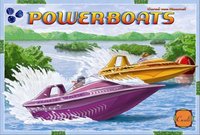
Powerboats. The other game from Cwali. This is a boat racing game with a pretty cool die mechanic. The game uses three-sided dice. You start with one and can adjust the amount with one each turn, either add one or remove one. You must roll any new dice and you can re-roll the old ones - or you can keep the old values. So, if you want, you can keep your speed. This is nice, as it reduces the luck of the draw.
The racing happens on a large hex map. The boats can only turn 60 degrees (one hex side) in turn and only before moving. There's a nasty rule where you must drive in a direction where there's enough room - if you roll too much, you can find yourself going in wrong direction. The water is full of obstacles, of course. It's simple and fun, so no wonder the game was popular. I thought it was entertaining and the game scaled to six players well. I'm just not very keen on racing games - if I was, this would be a mandatory purchase. Our game took 30 minutes for a single race, but with better players it would've been over sooner - I spent quite a bit of time in the bushes.
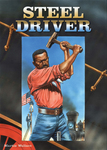
Steel Driver. This was one of the games I really wanted to try. Steel Driver is Martin Wallace's latest take on his earlier Prairie Railroads games - this is interesting because Wabash Cannonball shares the lineage. The games are somewhat distant cousins, I'd say. Steel Driver is different, but good.
The basic idea is similar. Railway shares are auctioned, the bid money is used to build track and players try to get as much money as possible. However, in Steel Driver money is purely points. The bidding is done with cubes: everybody gets the same amount of cubes each round. Cubes can be stored for use on later rounds. There are five rounds and each railroad sells exactly one share each round. Our five-player game took 65 minutes.
Once all shares are sold, the railroads operate. They can build one link on the map and gain income for the cities connected. This goes on for several rounds until all railroads have ran out of money and must pass. Passing order determines the order railroads operate on the next round. Players get money - points, that is - for the value of the companies they run each round.
Most of the points are made in the end, though. The map has cities of different colour and in the end, those cities are filled with cubes. The companies take turns picking cubes from cities where their networks reach, trying to collect sets of different colours. The bigger the sets, the more money the company makes. Each shareholder gets paid accordingly.
It's interesting. The end game is particularly curious, as it makes up for such a huge share of the money players make. The early game is basically setup for that end game. You want to get as many shares as possible in companies that will make good money in the end. That's a nice challenge.
The biggest difference between Wabash and Steel Driver lies in the money, I'd say. I like it, because the difference in the auction systems makes both games interesting and worth owning (I'm saying this because I already own Wabash and have ordered Steel Driver). For now I'd say I prefer Wabash a bit, but want to explore Steel Driver some more.
Instead of one huge post, I think I'll do several shorter ones. So, this is enough for now. Next up, Preußische Ostbahn... see part 2 for that and part 3 and part 4 for other games.
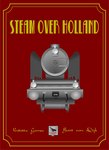
I've been too busy to write a session report from Finncon. Well, now I have time. I'll combine reports, as I just returned from our board game club, where I had a rather splendid little session. So, watch out for another blog entry of epic proportions... I played Steam over Holland in both sessions, so that'll get some extra attention.
Let's start with that. In Finncon we had five players: me, Olli, Robert, Ansi and Tombad. All were new. There was some fumbling with the rules, but generally Steam over Holland is pretty simple game - all of us were familiar with other 18xx titles. One of my biggest problems was to remember the 60 % holding limit - common rule in 18xx, but critically missing from my favourite, 1825.
That first game took about four hours. It was slow going a lot of the time... Olli for one is notoriously slow in 18xx (but not in other games), but the others took their time as well. Steam over Holland shouldn't be very long - after all, it's just five stock rounds and ten operating rounds, and that's it. The second game, with four players (me, Olli and two newbies), was just two hours 45 minutes, which was much better.
In both games one thing was clear: there isn't a lot of money going round. The first two or three stock rounds were pretty quiet, with not much trading going on. People simply didn't have money to buy shares. That meant that in the first game we played most of the game with five companies and in the second we used four railroads. Steam over Holland has an interesting rule where starting a railroad requires a purchase of N shares, where N is the phase number. That makes starting companies very expensive, so in the late game when you might have the money, it just isn't profitable anymore.
So, I'm a little wary about that: I would prefer more action with the shares. I kind of miss the question of when to dump the first company and to move on... In both our games starting a new railroad wasn't really an option. In the first one I decided that my railroad wouldn't do much, so I dumped it and invested elsewhere (and played as a pure investor or spectator the last four operating rounds, which was somewhat boring). In the second game, I just invested more in my own company.
Robert was very close to going bankrupt in the first game. Had I had 10 guldens more, I could've bought a train that would've finished Robert off. Instead he survived and went on to win the game with a heavy margin (2264, I was second with 1850). The second game was closer: one of the newbies won with 2106, I was second with 2088 and Olli third with 2024. The other newbie had 1661.
But it's a good game. I would like to see more stock round action and perhaps more companies in play. I do appreciate the shiny looks and the generally excellent production. This game is a pleasure to play. I need to experient with it a bit more, I suppose... perhaps trying to start more companies earlier or something like that, though I don't know where the money would come. I'll have to see... Fun game, and a good intro 18xx in my opinion, except the game is darn expensive (the downside of shiny components).
We also played West Riding in Finncon. West Riding is an auction game: a player chooses a railroad share to auction, and the winner of the auction gets the share and uses the money bid to draw some track on the map. More track means more dividends for the company. Individual company shares can be traded for grouping company shares, which gain value during the game and are very powerful in the end.
The problem with this game was the sheer amount of auctions combined with the difficulty of appraising the value of a company. It's very hard to say how much a company is worth, which makes the auctions rather hazy. Also, the Riding series system where there is at least one auction per player and then the auctions continue until someone runs out of money is slightly problematic - I'm not sure I like it here.
Our game was a bit strange anyway, as the lower grouping managed to cut quite a bit of the map for themselves, making those companies much better. It didn't really show in the prices, though, because all shares were terribly expensive anyway.
West Riding is a game for accountants: there's ton of book-keeping and calculation. The value of the railroads must be constantly re-calculated. Our game took, what, three hours or so, and I'm sure a proper computer version would cut most of that time. That's the only way to get me to try this game again... I think there might be a good game here somewhere, but it's drowning under calculation and confusing auctions. As it is, playing West Riding would be a waste of time I could use for better games. Nobody I played with will play the game again - I suppose that says something. These are not weaklings, either, but hard-core euro gamers.
So, in case somebody is interested, my game is up for sale. It's currently listed in Geek for 30 euros plus shipping, but I'm open to offers. It's such a small game that the shipping to US isn't much.
Then fast-forward to today. Our club had a nice turn-out, with four or five games going on most of the time. Plenty of Agricola - we had three copies available, funny enough. I started with some light fillers (Set which I totally dominated, Diamant which I didn't and some Crokinole, too).
We did play five rounds of Sheepshead, which is the American version of German Schafkopf. It's a nice little trick-taking game, best for five players (which is what we had). It's one of those fairly tricky games, an Ace-Ten game with funny trumps. Queens are the highest trumps, then jacks, then diamonds. Each player gets six cards from a 32-card deck and the two remaining cards are a widow.
One of the players is a declarer (first willing player starting from forehand) and the player holding jack of diamonds is the declarer's partner. They try to score 61 points. It's simple, if you're familiar with the type, but in our game few were. Outi in particular got a headache. It was fun, though, and I would definitely play Sheepshead again if I needed a five-player trick-taker where everybody plays.
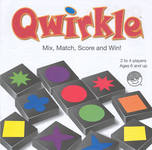
After Steam over Holland, I challenged Olli to a duel of Qwirkle. It was a close game, until Olli played some really nasty moves in the end ruining my game. Ok, so I did bump once or twice to my own nasty blocking moves, but that happens... It's a fun game, and I like playing it with just two players. We got an audience, too, which was fun - I suppose it would be nice to play in a tournament with people watching, that does give some extra boost to the game I guess.
One last game: I didn't have to ask Hannu twice to play some Le Truc. We played a proper three-game match, which I took home 2-1. The first game was a massacre, 12-2, I got good cards in just about every hand. Then I went and lost the second game 12-2 and finally won the last one 12-4. During the process we had some absolutely smashing hands, Hannu is a delightful opponent for Truc. This is a game I really, really recommend for two players looking for a fun game.
I spent most of my yesterday attending Tracon. Tracon is a yearly convention here in Tampere, this was the third time it was organized. Tracon is mostly about anime, manga and role-playing games. In the first two Tracon's, I don't think there was any board game presence, but this time the Finnish Board Game Society organized a small board game room. Since Tracon was close and friends from outside Tampere were attending, I joined the fun.
It was quite popular event, with about 3000 people attending (according to the web site). The defining element of Tracon was without a doubt cosplay. It seems to me that cosplay is the new live-action role-playing. When I was a teen, larping became popular (I was among the first major LARP wave back in 1994 or so), now it seems cosplay is the hip thing to do. Japan is very popular in general, I think most kids who start drawing comics these days adapt a very manga-influenced style and J-rock is quite popular.
Which is cool, and certainly made Tracon interesting to see. Most of the attendees were fairly young, I think. While board games in Finland are popular over wide age spectrum, the hard core hobbyists are "university age", that is 20-25 or so, well 20-30 perhaps (I'm getting closer to 30 myself, so extension is needed here). These cosplay folks are probably around 15-20. High school kids, that is.
Our little board game room (the event was held on the local technical university, a pretty nice venue actually) was a small class room, with nice differential equations decorating the black boards from Friday's lectures... It was a pleasant center of normality in the con, as most people in costume avoided it. We had a fairly small bunch of hard core board game folks, I'd say probably less than twenty people spent their whole day playing board games. That was quite enough, though, and quality certainly beats quantity.
Well, the costume people and other anime fans did play some board games as well. I had carried my Crokinole board and, fortunately, it saw almost constant action. I had a rules printout and many people had the patience to learn the game from the rules. That was admirable. I suppose it just looks too cool to pass. The cool factor certainly made the other hit of the day, Hamsterrolle. This group of anime fans played the game for a really long time, having quite a bit of fun. That was very nice.
I was hoping to play Roads and Boats, but the lack of people made that impossible. That wasn't a problem, as I then ended up playing lots of smaller games. Roads and Boats hits the table later, I hope. Oskari had asked me to bring bunch of games he hadn't played, and we ended up playing most if not all the games I brought, and that I consider major success.
As a warm-up, we started with Crokinole. I played with three newbies and the result was rather clear: after four rounds my team won exactly 100-0 (I always play four rounds or 100 points, whichever comes first). It was fun to flick the discs, it's been a while since I last played the game. It's just too heavy to carry in a bus, and nobody ever comes to my place to play games (might be because I never invite anybody).

Next up was Race for the Galaxy with Sami, and later I played the game twice with Oskari. It's a nice, swift two-player game indeed, and I even managed to win all three games. And I think Oskari mentioned something about coming to teach me how to play... Well, he did have rotten luck with his cards in one of the games, though I won the otehr despite having rather weak set of cards on table.

I played Dvonn twice, first with Mankka and then with Oskari. Both were new to the game, while I've played it 100+ times (mostly on Little Golem). Interesting enough, while I was able to give Mankka the typical newbie handling, winning every disc, Oskari was able to beat me.
Let me be the first one to admit that I'm fairly clueless with the game, despite my quite extensive experience, though. I've made it to the second level of Dvonn skill and got stuck there, I suppose. I don't mind, because I like playing the game as it is and if newbies can beat me, I'm not sure that's such a bad thing in the end.
Qwirkle was one of the hits. I played it first with Mankka, then with Oskari and as the very last game I played, we had one four-player game. I got some confirmation that the game has a skill element, as I was able to win both two-player games. With Oskari, the final result was 256-183, which was pretty heavy. With four-players, the game was closer. I suppose the two-player game is kind of easier, as you get more tiles and have more opportunities for high scores. I made some pretty nice moves against Oskari, 17, 20, and 21 points! My average was about 7.4 points per move, so those were good moves.
Everybody liked the game and I noticed Mankka taught the game to Cane from Boardgaming Finland. My opinion of the game improved, as well. I particularly enjoyed the two-player games, as they have more turns and less downtime. That's always a bonus, as I don't find player interaction the strongest point of Qwirkle (bit of fixed fun there, I suppose). Not that the four-player game is bad, unless the players are extra slow. So, yes, it's definitely a good game, but I think I'll need to print out a score board, as writing down the scores is kind of annoying.
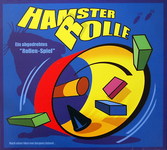
I played a game of Hamsterrolle as well. It's not my favourite dexterity game, but perhaps I just need more practise? Mankka was the only experienced player in our game and it showed, as his team won hands down. I guess I made the biggest blunder, dropping bunch of blocks from the wheel, thus sealing the fate of our team. Hamsterrolle is neat, but I actually might prefer watching the game.

Ubongo Extrem was on Oskari's list of games to test, so we played that next. Apparently Oskari didn't like it, at least not as much as regular Ubongo. I still prefer Extrem, the new scoring is just that good as it makes the game focus on puzzle solving. I do agree with Oskari that the timer is probably too long. I should find a quicker timer somewhere and try the game that way.

Kingsburg was the first new game of the day. This Italian-made game is basically standard resource management: players get cubes and turn them to buildings and victory points. There's worker placement, too. However, the main mechanism of the game is based on Yahtzee-like die rolling.
To start each round, players roll three dice. The board has 18 spots, numbered 1-18. Turn order is determined by the sums of the dice: smallest sum starts, biggest sum is last. Players can take any set of dice and place them on a spot marked with that number. So, if you roll 5-4-2, you could take spot 11 using all your dice, or take 9 and leave the 2 for later. Each spot can be chosen only once per turn, so you have to consider what other players have rolled. Players can also get +2 markers and some buildings allow a bit more flexibility.
Each spot produces stuff, with bigger, harder to reach numbers producing better results. Players must collect resource cubes so they can build buildings, but they also need soldiers. After three turns, there's war against enemies of the kingdom and if players don't have enough soldiers, they'll suffer penalties. There's some pressure and tension there, particularly in the end game when the opponents get tougher.
It's pretty neat and unusual. Oskari wouldn't want to play a five-player game and I can see why: the game has plenty of analysis paralysis potential. Choosing how to use the dice takes some thinking and the situation is sometimes hard to predict, so it's easy to get stuck. We managed to play our four-player game in 70 minutes, which was ok.
I think Kingsburg is ok, but not much more. My main problem is that I didn't have fun playing the game. Quite the contrary, I felt frustrated. I wanted to achieve things, but collecting resources was hard and with the dice having so big a role, it wasn't good hard. I don't mind difficult games, but here I felt I was too much at the mercy of the dice. So, I'd say try before you buy if possible, as I'm quite sure this game isn't everybody's cup of tea.

Fresh Fish was another one of Oskari's wishes. Too bad we didn't get anybody else playing. I can assure you this was quite likely my first and last two-player game of Fresh Fish ever. It just doesn't work with two, the board is too small and the auctions get uninteresting. Well, at least Oskari got some idea of how the game works, and he did seem to appreciate the road mechanic, despite his low initial rating for the game in Geek (6, but I wouldn't given a better rating for this particular game either).

Me and Oskari were getting slightly desperate with playing two-player games, that's my excuse for agreeing to play Pünct. I still don't like it, and I actually went and dropped my rating at Geek from six to four. I don't like it, but apparently can be talked into playing it occasionally... Pünct is easily my least favourite in the Gipf series.
Halli Galli Extreme was my party, but then again, opponents were all newbies to Extreme (some were total Halli Galli newbies). It was the same with Flix Mix, where I dominated against players who played by correct rules (one of them didn't, and won the first round).

Next, Tommy appeared out of nowhere (apparently he had been ice-fishing the whole day and decided to join the fray for few hours). Nice surprise! We instantly recruited him to our game of Dia de los Muertos. It was an interesting match of this old trick-taking twister. Points in this game are made of two cards: a soul and food to feed it. Me and Tommy got most of the food, while Oskari and Marko got most of the souls. Too bad we got two souls while they got only one food...
It's a twisted little game with lots of chaos and twists and turns, yet the game offers some good possibilities of control and deduction. I like it. Our game was curious, as of the nine possible points, we scored only three. A bit lame, I suppose. Cue the mantra: I need to get this out more often. Oh, and now I know: Four Dragons is going away, I'm selling it.
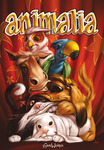
One final new game: Animalia. This is apparently fairly rare filler game, where players try to collect a good set of five animals. Basically you try to collect as many animals of the same kind as possible. If you have at least two of the same animal, you get as many medals as you have those animals. Single animal is worth nothing, unless all your animals are different.
After three rounds, most medals wins the game. There are few twists. First of all dedication helps, as you get extra bonus of five points for every five medals of one kind. Some animals have special abilities, allowing you to give away your animals or steal someone else's animals. Some have stars, and whoever has most stars after a round, gets bonus cards they can use to improve their collection.
It's all fairly simple and entertaining. The game looks pretty cool. The cards have few symbols, though, the different special abilities are integrated in the art. It's neat, but takes some getting used to. We had a bit of a problem, though: we ran out of medals in the end. The rules say nothing about running out of medals. Is that possible? We don't know. It certainly happened. So who gets the last medal? We don't know. The rules don't have a word about it.
That was a bit of a bummer. Later discussion on the Board Game Society forums seems to imply that medals are unlimited, as in the card game version there are no actual medals, they're just counted on paper with no limits. That makes sense, but it still makes things a bit difficult for the version with the insufficient medal tiles.
So, not my favourite, and while it's decent filler, there are plenty of better fillers that have complete, unambiguous rules.
And that's it. Tracon was fairly well-organized event from our point of view. We had the classroom and it was enough for us (though bit more traffic at the peak times and we would've run out of space), our tested game borrowing system worked well and didn't require much effort from our part. People played games and had fun.
Thanks to Mika for organizing a pizza delivery, that solved the food thing well. I didn't even have to leave the game room to eat, how efficient! I will definitely attend Tracon again if Board Game Society decides to have some presence and it fits in my schedule.
Another Helcon is gone (well, they're still playing, but I'm already back home) and boy, it was a good one! We started games on the train to Helsinki. Robert managed to get himself to the wrong train (for some reason there were to trains to Helsinki within three minutes), but I had Olli and Sami with me, so we could play. I had hoped to play something with Robert already on the train station - thanks to a holiday bus schedules, we both had to arrive quite early - but a train station full of drunks just isn't the best possible environment.
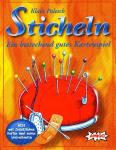
It's been a while since I last played Sticheln - so that's what we played. Olli had some limited experience and hadn't really made up his mind yet, but seemed to like it better now. Sticheln is good - as long as you stick to three players. We played six rounds and while I played some weaker rounds, we managed to beat Olli back from the top and I was able to take over. Ain't completely rusty!
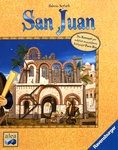
We squeezed in a quick San Juan before the train got to Helsinki. A good game, which I lost because I finished it too quickly. Sometimes rushing isn't the best strategy, especially if you're missing a critical big building.
In Helsinki we met with Robert and made our way to the location. It's been cold, and it's started to snow, too. So, there we were, waiting for the doors to open with rather wet snow falling over us... Fortunately we didn't have to wait too long. After a quick trip to a close grocery store, I was ready for action.
While waiting for the tournament to start, I got into a game of the Holy Grail, I mean Race for the Galaxy. It was somewhat rushed, we had 45 minutes and that's what the game took. I think I figured it out pretty well, but others had more trouble with it, and I don't think it was a particularly pleasant first touch.
I loved the game, though, and I'm rather glad I've got my copy coming, hopefully early next week. The game rocks. It's like San Juan, only better. The simultaneous action selection works well, I like the consume mechanic, the card selection is interesting and, simply put, the game was fun! I got the New Sparta as my starting world and that settled my strategy: I got the Galactic Imperium and started exploring like crazy for rebel worlds to beat down. Add to that the New Galactic Order that rewards for military power and it works like a charm... or would've, had Ansi not hoarded rebel worlds when he noticed (or, when I was excitedly blabbing out about my delightful discovery) that I needed them.
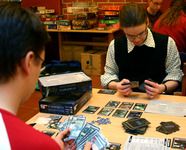
Game of the year, hands down. It's seriously good. There's a downside, no doubt about it, though - the game is a bit complex. I can see trouble ahead: the game seems designed to be played fast and I like that, but playing with newbies or simply slower people who'd like to take one phase at a time just might be too much for my nerves. Give me experienced opponents and I'll pick Race for the Galaxy over San Juan every time, but with newbies, I don't know.
Then, the tournament. It was a team tournament with three-players teams and three rounds. On each round, the teams first voted which games they wanted to include and then put the chosen games in order of preference. Each team got three games to play and could assign team members to different games any way they wish. I instantly recruited Robert to my team and when I heard Olli was coming too, I got him as the third member of our team, Tampere Avengers.
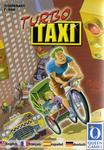
First round was light games. I got into Turbo Taxi, our other games were San Juan (Robert, our expert, took that and won) and Fairy Tale (Olli played this one, enjoyed the very competitive and brutal game a lot, but didn't win). I believe I'm pretty good at Turbo Taxi, but still lost my game. It was tough. Stefu won, and I know he's good... I hadn't practised in a long time, so I was perhaps a bit rusty.
Still, it was a major embarrassment. I should've done better! Losing was completely out of question, with two (or one) newbies in the game! I don't know if I like the game anymore... Well, it's not bad, but it's definitely not my favourite speed game, never was - it's just not as much fun as some other games. I think I somewhat prefer slightly slower games: Flix Mix is a good example of a speed game with a slower pace, as is Sunda to Sahul - these two are my favourites, actually.

Next round was medium-length games. Robert got Carcassonne and lost that, not a surprise really, while Olli tackled Einfach Genial with little success. I got Industrial Waste. It was a curious game: it was the longest game of the round and probably the longest game of Industrial Waste I've played. I drew a disaster after disaster from the pack. Mankka, Stefu's brother, was particularly badly hurt as he was most of the time on the red. He ended up, what, 40 millions in debt - yet still got a pretty decent amount of points.
I was second: I only had to take one loan, which I paid back on the last round. I didn't have enough money, so perhaps more aggressive lending could've helped a bit, but Marko who won, did fairly well without taking any loans at all, so beating him would've been hard. A good, tough match that dragged out perhaps a tad too much, showing the ugly side of Industrial Waste - and a probable reason why it isn't a top-tier game. I still think Rio Grande should re-issue it as Al Gore's Industrial Waste.

Last round had me playing Amun-Re, which I wouldn't have chosen to play otherwise... I did my basic standard Amun-Re performance: two pyramid sets, some bonus points, but nothing big and ended last. It was a pleasure to see Petri, one of the better board gamers in Finland, play. Robert played Tigris & Euphrates and won, Olli struggled a long game of Imperial and won, too, I think. Thanks to the somewhat better last round, our team ended up, I believe, fifth out of eight teams. Not bad, but not quite what I believed we could do...
The tournament was quite good. It would've needed a computer to do the set up and there were some kinks in the selection system, but it worked out pretty well in the end. We got mostly the games we wanted, with some disappointments. Would I participate again? I don't know - perhaps I would've preferred to play something else. Turbo Taxi and Industrial Waste were good games and tough fights, but the Amun-Re just wasn't much fun. Also, the tournament would've been more fun if people would've known the games - now each game had newbies in it, which sort of removes some of the attraction of the tournament setting.
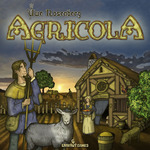
After a late lunch break - pizza from the grocery store, no expensive two-hour restaurant meals this time - I was more than happy to join Tommy in Agricola. I've been skipping the Essen stuff, mostly, but this one did pique my interest. For a reason, it seems! We quickly found out we had a full set of five players and a table full of cardboard: while Agricola is not a big league table hog, it still takes a large table to play it.
Agricola is a "life game": each player starts with two family members in a two-room wooden hut and tries to make a living. The family grows, builds a bigger house, farms the land, raises animals and tries to get enough food to feed all hungry mouths. Each turn each family member gets to do one action: typically actions either get more basic resources or use them to do something useful.
We played the basic, family game without any of the special cards. Apparently they give the game more flavour, but it's quite good even without them. Our first game took two hours, including plenty of reading rules and we did get quite a few things wrong, making the game slightly harder than it should've been. Still, it seemed interesting and most of us wanted to play a second round, this time with what I think were the correct rules.
The game sure flowed much faster. We finished the second game, with four players, in about 70 minutes. Not bad! The game is basically resource gathering and there are plenty of things to do, yet little time to do them. There's no direct player interaction, except for the competition over the actions, which are a scarce resource if any. I like the scoring: it's quite intuitive, as you get points for everything. It's also fairly clever: most things give you negative points if you don't do them, so you'll have to balance doing a little bit of everything and doing plenty of something, as if you only do a little bit of everything, nothing's going to get you lots of points.
So, yes, I love it. After that first game the game jumped from "hmm, this seems interesting" to "must buy as soon as the English edition arrives". I'm waiting - there's just too much German. It's not that bad, at least except for the cards, but still I'd rather wait. Having an English edition makes it just that much easier for the other people I'd play with, even if I can cope with the German (I've realized I've learnt quite a bit of German).
I'd also like to add that Agricola does have elements that can cause disturbing table talk, particularly the bits about having babies and perhaps the bits about animals as well... So yeah, we did have a blast playing this. I don't remember when playing a game was this much fun. And it's not just fun, but there's really a sound, mechanically solid game underneath that flavour and theme... Agricola is definitely high on my list of well-themed games.
Funny fact: Agricola - Latin for farmer - is also the name of the bishop of Turku from 16th century, who translated the Bible to Finnish and thus created the written Finnish language. Mikael Agricola was no farmer himself, but got his name from his father, who was. He's famous enough to be the first thing that pops into the heads of Finnish gamers who hear about this game.
I had organized a card game session at the end of the evening. We played Hungarian Tarokk and Doppelkopf. Tarokk was good as ever, though it was obvious it would take a lot more plays to make it more interesting. New players are simply too timid to bid, even with really, really good cards, and that somewhat hurts the game. I can understand that, and I think I'll need to encourage people to bid more, as winning the games as a declarer really isn't that hard (and losing is a good way to learn).
Doppelkopf was a new experience for me. Markku aka JoeLamer had played the game against computer opponents and in BSW. It's a tricky game: basically it's a standard ace-ten game played on a double 24-card pack, but the trumps have been complicated a lot. Ten of hearts is the highest trump, then queens, then jacks, then the rest of the diamonds in normal order. Plenty of trumps, as each card is doubled!
It takes lots of play to get one's head around all of this. I am humbled by the fact that Doppelkopf is very popular in Germany and played as a social game: nobody, and I mean nobody, plays games this complex in Finland for fun (I'm not counting Bridge, which is in any case pretty simple except for the bidding and perhaps the scoring). Talk about card game culture! We played three hands and each time I found myself holding one of the club queens, which made me part of the declarer's team, so to speak.
Doppelkopf was fun, but I don't think I'm playing it a lot. It's just too darn complex and would require lots of repeat play. I suppose it could be a fun way to spend few hours with three like-minded individuals as that would give enough time to get one's head around the game, but otherwise... well, there are games that are less complicated and pretty much just as entertaining.
As the tradition goes (last year, the year before that, the weekend before that, the year before that...), I met Tommy for a day of games. So, this year it was just me and him, and just a single day. It was great fun nonetheless.
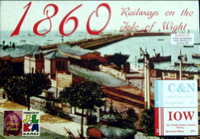 We kicked off with 1860: Railways on the Isle of Wight. It's a small 18xx game, for two or three players basically. It worked well with just two of us. The map is small and the game quite constricted.
I enjoyed it. The game features interesting stock market moves: a company that pays out big dividends gets a huge boost in share value. So, dropping the value to keep money in company to buy a better train is not a big deal, as the new train and the increased revenue will make the share value soar.
I lost, in the end, 13000-11000 or so. That's still the largest number of points I've collected in any game, I suppose... My fate was sealed quite early, when we bought our second companies. I invested in FYN, which in retrospect was a really, really daft move. I might've got my investment back, maybe, while Tommy's second company was a major money maker. Well, you live and learn, and starting new companies is one part of the 18xx game I feel a bit uncertain about.
So, it's good, and if I played four-hour games more than few times each year, I'd probably hunt down a copy. It's that good.
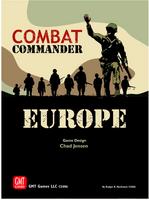 After four hours of trackbuilding and stock markets, we moved to World War II. I revisited the Belgian chateau in Combat Commander: Europe, as I thought that would be an interesting introduction scenario - enough stuff, clear objective and so on. Well, that wasn't quite as successful as 1860.
Tommy, playing the Allied liberators, assaulted the chateau in a very straightforward manner. Protected by smoke he did a pretty good job, too. In the end I did squeeze the victory: he was doing well, but wasn't quite finished in the chateau when he ran out of time.
Tommy's initial rating is six, so he clearly didn't love it. I can see why - this playing made me to drop my rating to eight as well. I like it still, but the game just feels a tad too long for the meat of it. Antiquity, for example, seems to offer more decision-making goodness in the same timeframe.
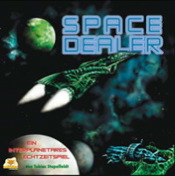 Next up was some three-player games as Tommy's wife Laura joined us. I didn't mind: Space Dealer was high on my list of games I'd like to try. I'm glad to have that past me now, as I wasn't quite enamoured with the game. The concept is great, but it just wasn't that interesting.
The rules are a bit muddy, and I think adding some of the advanced rules could help, but somehow it was quite stale. I had time to SMS my wife while playing - so much for time pressure... We ran out of objectives to fulfill in the end, too, which added some extra frustration. I can try the game again, but I have definitely no need to buy it.
 Factory Fun, in the other hand, was good fun and something I wouldn't mind owning. As puzzle games come, this is pretty solid offering, and while newbies will find it hard to beat an experienced players, building your factory is a fun exercise.
Well, maybe not, if you lack the visualization skills necessary, but still - I think it's pretty fun to arrange the pipes and the machines, and once you get them connected and something's kind of working in your factory, it gets pretty entertaining.
 Through the Ages has been another title I've been curious to try. The concept is great: a civilization game that moves swiftly and does away with the boring military stuff. There's no map and no units to move on it - isn't that just great!
The game is quite abstract and it took me a while to wrap my head around the system and figure out how it works (and I'm still a bit fuzzy about the happy faces stuff). So there's a learning curve there, and it's of the steeper variety. However, once you figure it all out, it makes sense. The system is just brilliant. One of the definitely highlights in the world of new games, I'd say.
Despite the length of the full game (we played an advanced game, and I very much want to play a full one as soon as possible), this one's definitely on my buy this list once the new edition comes out (unless they ruin it somehow).
 While waiting for sauna, we played a quick game of Celtica. My victories were scarce during the day, but this one I won, thanks to Tommy's reckless card drawing - he played more cards on just about every turn, giving me the first shot on just about every round (not a small advantage, come to think of it). I still think Celtica is a great filler and one of the better games of 2006.
 Then, as the last game of the evening, Goa. Last time I played it, it left me with a sour taste. I should like it, and now, given another chance, I did enjoy it better. It's not a bad two-player game, either. Not my favourite optimization game, no, but clearly better than I initially thought.
So, it was a fine day of games (add in some Guitar Hero II on PS2, that was fun as well). The two-player concept worked great. Playing some Splotter games would've been nice, but since both me and Tommy do prefer the new games, this was good.
Helcon 2006 was a blast, and the most successful event of the Board Game Society history with almost 100 participants. I was there for the Saturday (limitation caused by being a parent; unfortunate for the gaming, but rewarding in other ways). I didn't play that many games, but as you will see, sometimes (well, often) quality is more important than quantity.
I got the first taste of games before the actual event, when I met Robert on the Tampere railway station. We got ourselves a table at the train and spent the trip playing games. Train left 30 minutes late, but hey, that doesn't matter when you've got games to play, right? We played few rounds of Blue Moon - always a pleasure, and Robert seemed to warm up for the game as we played too - followed by a round of Battle Line.
We used the tactics cards, because Robert was familiar with the Schotten-Totten version and wanted to try the game Battle Line style. I've been avoiding them, and this game reassured me my decision has been good. I find that the tactics cards add relatively little to the otherwise clean and elegant game.
We finished the games with a match of San Juan, played almost at a BSW pace. San Juan as a speed game, that's something I quite like.
The definite highlight was the first actual game of the event: 18VA. I ordered the game a long time ago, and finally got it in my hands. The production values are surprisingly good: the game looks really good. It's all very well done.
The game was great, just great. It took us about 30 minutes to figure out the rules (I had studied them, but we had some problems; some things could've been explained better in the rules, I think) and four hours to play the game. I know we had a ton of minor rules mistakes (very difficult to avoid in a complicated and fiddly game like this) and lots of blunders caused by the freshness of the players (all newbies, two having some 1830 experience from the PC version). Still it was great.
I won, too. The scores were very close: 5682-5393-5234-5148. I had the second best stock portfolio in the end (Tommy who was second had the best) and most cash in hand. I was a bit surprised by my victory, as I didn't feel like one of the power players in our game. I was the president of my small Virginian Railways from SR 1 to the very end, and that's it. I did have two of the privates, which my Virginian bought with the full price (and one of them was the $200 discount on trains, making sure I hadn't visit my personal cash reserves to buy trains like Tommy), that pretty much makes up the difference to Tommy I think.
Next time I'll know the rules better, and maybe it'll be even better. The playing time is a bit tough, but I think it can be squeezed to four hours including the rules explanation. I'm looking forward to have another go, I just don't know when that's going to be possible. Anyway, I'm now happily in the 18xx world, having perhaps dived in a fairly deep end, but I'm glad I have the game. As of now I feel no need to buy more 18xx games, but we'll have to see about that.
After a Nepalese dinner (quite like Indian, really), it was time for more trains. The game was Age of Steam, with JC Lawrence's London expansion. It's a really neat map - both in artistic and gameplay sense. The only problem is the huge size: the map doesn't fit in the box.
The game had two newbies in it, so I couldn't properly enjoy the cruelty of the map, as my game was fairly easy cruising. When you can get Locomotive for $1, you know everything's just fine... Well, the proper appreciation of engine power is something new players tend to learn towards the end of the game, which was the case this time as well. The new players got to five links on the last round, when I had already ran many rounds of five-link runs and got some six-link runs on the last round.
I like the new stuff on the London map. The instant production (new cubes arrive immediately after a cube is delivered, either to the begin or the end of the run) is fun, as is the ability to build up to five tracks, but with a heavy cost. We got the Urbanisation action wrong (there was a limitation I didn't notice) but that didn't matter much.
I had asked a friend to bring Reibach & Co he had bought from Essen. I've been talking about playing Union Pacific without the map, and here it is: Reibach & Co (or Get the Goods) is basically the stock mechanism of Union Pacific. I enjoyed it; it's not a great game, but good, and definitely better than Union Pacific.
I bought an used copy of Gipf and played a match, but with so wrong rules that it's a different game. Well, maybe next time I'll have the correct rules. I also bought Gipf Project Set 2, which contains the very necessary extra rings for Zèrtz.
Two Werewolf matches made it into my schedule. Those were fast and hilarious. Once again it was proven that I look guilty and werewolfish, even though I was innocent in both games. In the first game werewolves were able to take the victory, while in the second, we lynched a wolf on the first hanging and got the second one in the end. Good times, good times, particularly thanks to Anna, whose semihysterical defense speech after getting one vote in a test vote (not the actual voting round) was just excellent - of course she was hanged after that, and of course she was innocent.
Markku (JoeLamer from BSW) had bought a copy of Mauer Bauer and needed someone to explain the rules. Well, here's a Colovini game I'm always willing to play! Hopefully the rules got through; at least I beat the opposition neatly. It was a curious game with a huge megacity, which made things interesting.
Stefu had challenged yours truly and the world champion Markus to a speed game triathlon; that dwindled down to a match of Turbo Taxi between me and Stefu (and Phil, whose participation in the game was quite minor, in the end). Stefu got a good lead, but in the end made few blunders and I was able to even the score. I consider that a quite perfect result.
That's it, pretty much. There was a superb raffle with good prizes, with some very interesting games to win (and less interesting, as well). I got lucky and won a copy of Um Reifenbreite (which I played with Johanna yesterday; she didn't like it, and I don't think it's a particularly good two-player game). Not a bad prize at all!
The last game of the evening was a three-player game of Gang of Four at Tommy's, where I smoked the opposition. Overall my Saturday was full of victories, which was nice.
So, another Helcon gone. The quality of the event is better each year; it's definitely my favourite game event. Thanks to all organisers and people I played with!